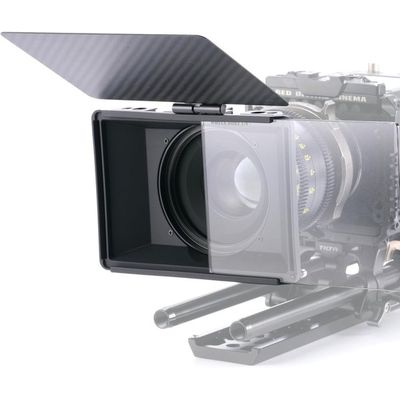
Tilta Mini Matte Box
Since the FX3A has no built-in ND, you need filtration. This takes 4x4 filters, weighs almost nothing, and includes the rod adapter and four lens rings.
Check price on AmazonThe FX3A is the camera most US solo filmmakers end up buying. It is small enough to fly on a gimbal, it records 4K120, and it has the audio inputs and card redundancy that paid work demands.
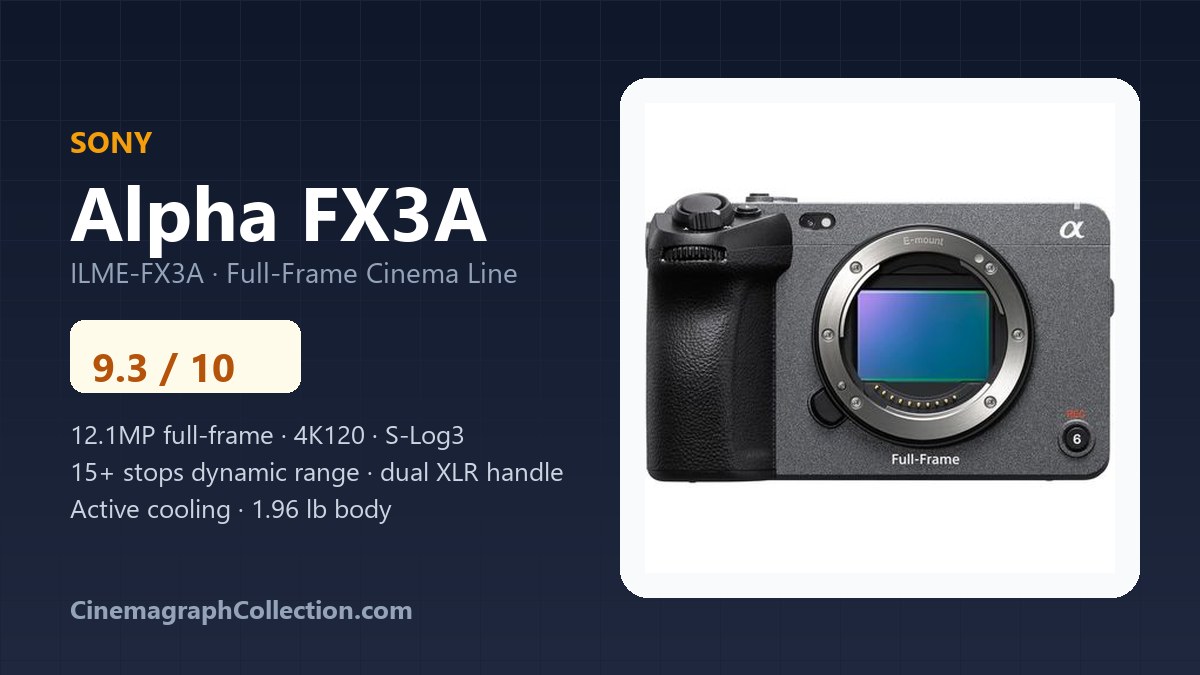
Buy the FX3A if you shoot solo, on a gimbal, or run-and-gun, and you want a full-frame body you can carry all day without a crew.
Skip it if you need internal RAW, built-in ND, or you already own an FX3 — the two cameras are nearly identical.
Best alternative: the Sony FX6 for crewed work with built-in ND, or the Nikon RED Z Cinema ZR if you want R3D RAW and RED colour straight out of the body.
Manufacturer figures, cross-checked against independent measurement where available.
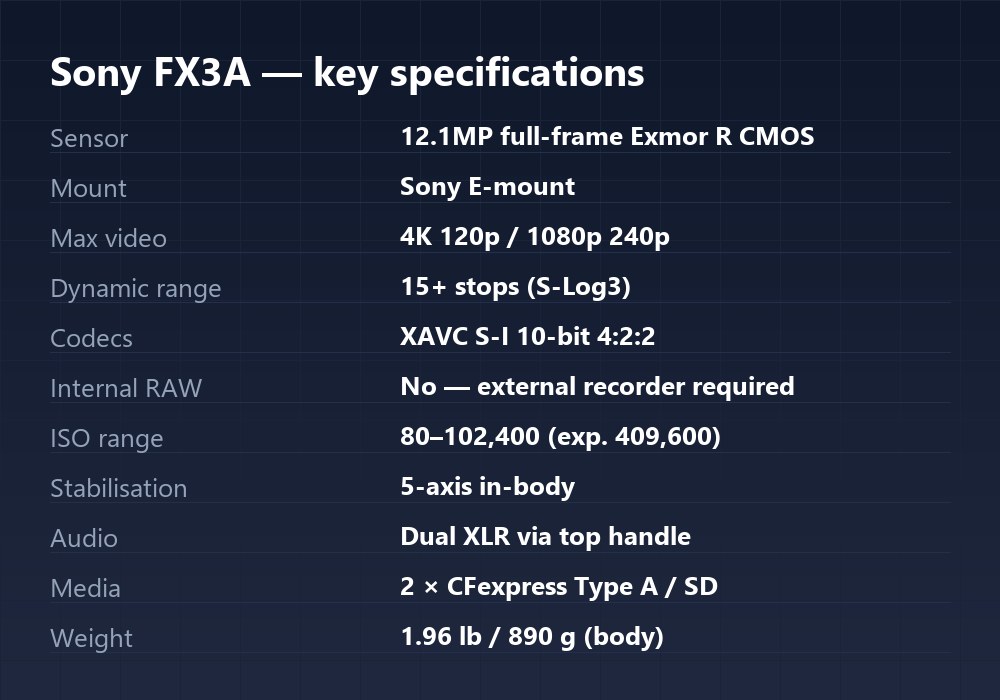
| Sensor | 12.1MP full-frame Exmor R CMOS, back-illuminated |
|---|---|
| Lens mount | Sony E-mount (PL, EF and MFT via adapter) |
| Maximum video | 4K UHD up to 120p · 1080p up to 240p |
| Dynamic range | 15+ stops in S-Log3 (manufacturer claim) |
| Colour science | S-Cinetone, S-Log3 / SGamut3.Cine, HLG |
| Internal codecs | XAVC S-I 10-bit 4:2:2, XAVC HS, XAVC S |
| Internal RAW | No — 16-bit RAW output via HDMI to an external recorder |
| ISO range | 80–102,400 standard, expandable to 409,600 |
| Stabilisation | 5-axis in-body optical stabilisation |
| Audio | Dual XLR inputs via supplied top handle, plus 3.5mm and digital MI shoe |
| Media | 2 × CFexpress Type A / SD (UHS-II) slots — relay and simultaneous recording |
| Monitor | 3.0in vari-angle touchscreen (higher resolution than the FX3) |
| Battery | NP-FZ100, roughly 2 hours continuous 4K; USB-C charging |
| Weight | 1.96 lb / 890 g body only |
The FX3A is a revision, not a new camera. That matters a great deal when a used FX3 is on the table.
This is the single most important thing to understand before you buy. The FX3A is not the FX3's successor in any meaningful sense — it is the same camera with a handful of specification adjustments. Sony's own documentation confirms the sensor, video modes, codecs, autofocus system, stabilisation and XLR handle are unchanged.
| Feature | FX3 | FX3A |
|---|---|---|
| Sensor & video modes | 12.1MP FF, 4K120 | Identical |
| Codecs & autofocus | XAVC S-I, real-time Eye AF | Identical |
| Stabilisation | 5-axis IBIS | Identical |
| XLR top handle | Included | Identical |
| Rear screen | Standard resolution | Higher resolution |
| USB port | USB 3.2 Gen 1 | Full USB-C |
| NFC pairing | Yes | Removed |
| IR remote control | Yes | Removed |
Read that table again. The FX3A adds a better screen and a modern USB port, and it removes two features people actually used. If you run a multi-camera shoot with an IR remote, or you rely on NFC for fast pairing in the field, the older FX3 is arguably the better camera.
Our advice is simple: if a used or discounted FX3 is available at a meaningful saving, buy the FX3. The image is identical. The money you save buys a lens.
Six features that matter on set, explained without the marketing language.
Twelve megapixels sounds low until you remember this is a video camera. Fewer, larger photosites mean better low-light performance and cleaner highlights than a high-resolution stills sensor. The sensor is back-illuminated, which is a large part of why the FX3A holds up at ISO 12,800 in a dim reception hall.
It is worth being precise about the resolution trade-off: 12.1MP gives you a full-frame 4K image with no pixel binning and no line skipping. That is why the footage looks as clean as it does.
High frame rate with reliable autofocus is genuinely rare. Plenty of cameras will give you 4K120, but most drop autofocus, crop the sensor, or overheat within minutes. The FX3A does 4K120 with real-time Eye AF and a modest crop, which makes slow motion usable for paid work rather than a novelty.
1080p reaches 240fps if you need extreme slow motion, though the quality drop is visible and it is best reserved for short inserts.
The FX3A is not exciting. That is precisely why it works. It does 4K60 all day, the autofocus tracks, the audio is clean, and nothing about it draws attention to itself on set. — Our assessment after reviewing owner and rental-house reports
Fifteen stops is a manufacturer figure, and like all such figures it assumes perfect exposure and a proper grade. In practice, the FX3A gives you enough latitude to hold a bright window and a lit face in the same frame without a filter stack — which is the practical benefit, whatever the number says.
If you do not grade, shoot S-Cinetone instead. It produces a finished-looking image straight out of the camera and is one of the more useful features here for fast-turnaround work.
This is the feature that separates the FX3A from a stills camera with video modes. The included handle gives you two full-size XLR inputs with physical gain dials, so you can run a shotgun and a lav receiver without a separate recorder or a dangling adapter.
For documentary and event work, that single detail removes an entire failure mode from your kit.
The FX3A has a fan. That is unusual in a body this size and it is the reason the camera can record long 4K24 and 4K60 takes without the thermal shutdown that plagues smaller bodies. Interviews, ceremonies and long-form documentary work all depend on this.
The honest caveat: owners do report shutdowns when shooting 4K120 in direct sun or extreme ambient heat. Plan shade and breaks for high-frame-rate work in summer.
Dual CFexpress Type A / SD slots give you simultaneous or relay recording — the redundancy that makes a camera safe for paid work. At 1.96 lb the body balances on a one-handed gimbal without a counterweight arm, which is why it has become the default for solo shooters and wedding teams.
The vari-angle screen is genuinely useful for low and high angles, and it is the one area where the FX3A improves measurably on the FX3.
Every advantage and every compromise, with the reasoning attached.
In normal use, no. The active cooling handles long 4K24 and 4K60 takes, and the overwhelming majority of owner reports describe all-day shooting without a shutdown. The exception is high-frame-rate work in heat: 4K120 in direct sun has produced thermal cut-outs for some owners, particularly at 30 minutes and beyond.
The practical answer is that this is a manageable problem, not a design flaw. Shoot high frame rate in shade, take the standard breaks you would take anyway, and it is a non-issue. Shoot 4K120 continuously on a beach in July and it will eventually stop.
No, and this is worth correcting because the FX3A is frequently confused with the APS-C FX30, which does have noticeable rolling shutter artefacts. The FX3A uses the same full-frame sensor as the FX3, and the owner consensus is that rolling shutter is invisible in the vast majority of situations. You have to push it deliberately — fast pans, whip movements, strobing practical lights — to see it at all.
Excellent for the category. The combination of a 12.1MP full-frame sensor and dual native ISO behaviour means ISO 12,800 is usable and 25,600 is acceptable for documentary work where grain is tolerable. This is the main practical advantage the FX3A holds over higher-resolution full-frame bodies from the same generation.
Rolling shutter is the criticism most often aimed at this camera, and it is the one criticism the specification does not support. The FX30 has that problem. The FX3A does not. — Correction note, October 2026
The three cameras most US filmmakers are actually choosing between at this price point.
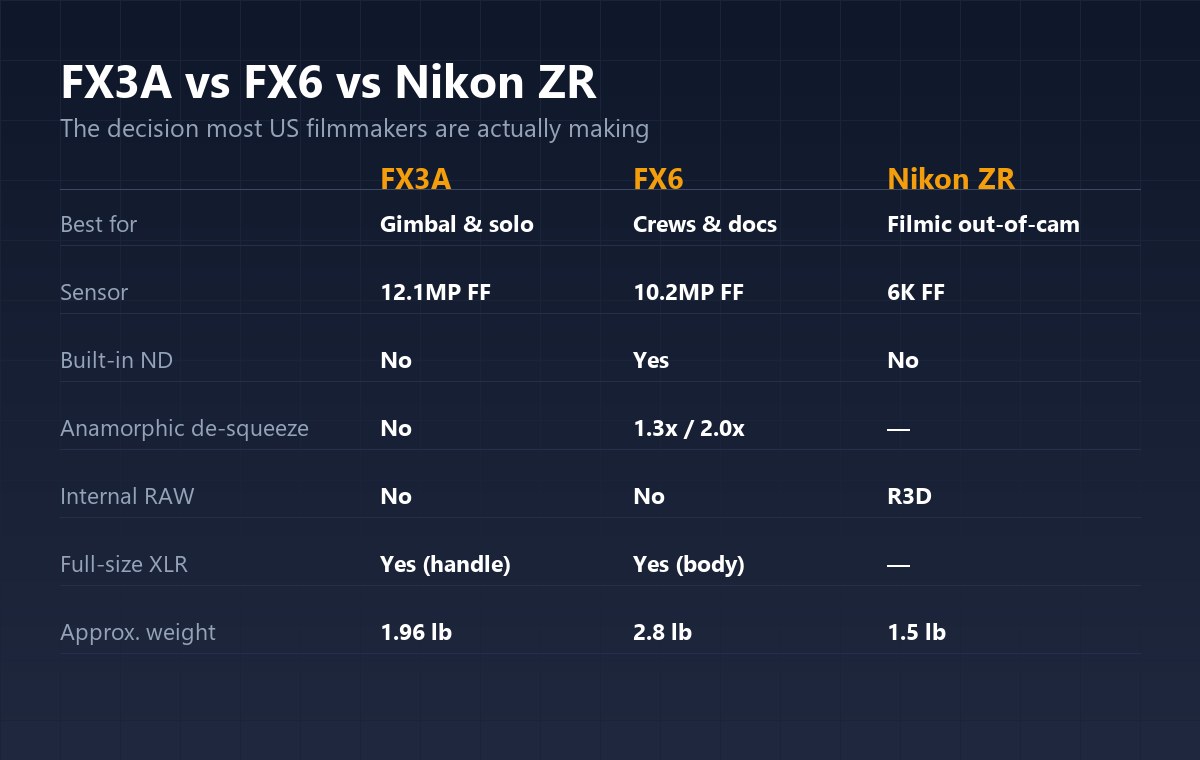
| Specification | Sony FX3A | Sony FX6 | Nikon RED Z ZR |
|---|---|---|---|
| Best for | Gimbal & solo work | Crews & documentary | Filmic out-of-camera look |
| Sensor | 12.1MP full-frame | 10.2MP full-frame | 6K full-frame |
| Maximum video | 4K120 | 4K120 | 6K |
| Built-in ND | No | Electronic variable | No |
| Anamorphic de-squeeze | No | 1.3x / 2.0x | — |
| Internal RAW | No | No | R3D |
| Full-size XLR | Via handle | On body | — |
| Body weight | 1.96 lb | ~2.8 lb | ~1.5 lb |
| Our score | 9.3 / 10 | 9.1 / 10 | 9.4 / 10 |
The FX3A has no built-in ND and no follow focus. These three fill the gaps.
Since the FX3A has no built-in ND, you need filtration. This takes 4x4 filters, weighs almost nothing, and includes the rod adapter and four lens rings.
Check price on Amazon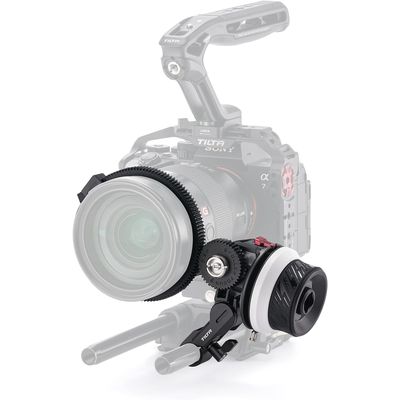
Fluid damping and A/B hard stops make focus pulls repeatable. No batteries, no pairing — it just works every time.
Check price on Amazon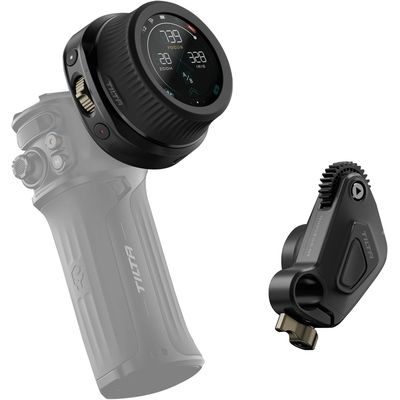
Wireless focus, iris and zoom from a touchscreen handwheel. The upgrade to buy if you shoot solo and cannot reach the lens.
Check price on AmazonThe FX3A does not win on specifications. The Nikon ZR beats it on resolution and internal RAW, and the FX6 beats it on built-in ND and crew ergonomics. What the FX3A wins on is not getting in the way. It is small enough to carry all day, the autofocus holds, the audio is clean, the cards are redundant and the fan keeps it rolling.
That combination is why it became the default choice for solo US filmmakers, and why it still holds that position. The only caveat worth repeating: if a used FX3 is meaningfully cheaper, buy the FX3. The image is the same.
Check price on AmazonOnly if the price is close. The sensor, codecs, autofocus, stabilisation and XLR handle are identical between the FX3 and FX3A. The FX3A adds a higher-resolution rear screen and a full USB-C port, but it removes NFC pairing and IR remote control. If a used FX3 is meaningfully cheaper, buy the FX3.
Not in normal use. The FX3A has active fan cooling and handles long 4K24 and 4K60 takes without issue. Owners do report shutdowns when shooting 4K120 in direct sun or high ambient temperatures, so plan shade and breaks for high-frame-rate work in summer.
No. The FX3A uses the same sensor as the FX3, and rolling shutter is not a practical problem for narrative, documentary or commercial work. It only becomes visible on very fast pans or whip movements. The camera often confused with it, the APS-C FX30, has noticeably worse rolling shutter.
No. The FX3A records 10-bit 4:2:2 internally in XAVC S-I and XAVC HS. For 16-bit RAW you need an external recorder such as an Atomos Ninja connected over HDMI. The Nikon ZR records R3D internally if internal RAW is a requirement.
Yes, and it is one of the most common choices for that work in the US. The small body balances on a gimbal, the autofocus tracks reliably, dual card slots give redundancy, and the dual XLR handle captures clean audio from a shotgun or lav receiver.
Sony E-mount. It accepts native E-mount glass directly and PL, EF or MFT lenses through a mount adapter. Adapted PL glass is common for cinema work, though autofocus is unavailable with most adapters.
With the NP-FZ100 battery the FX3A typically runs around two hours of continuous 4K recording, longer for intermittent shooting. It charges over USB-C while powered, so a power bank extends a shooting day without swapping cells.
Buy the FX3A if you shoot solo, gimbal or run-and-gun, and you want the smallest full-frame body. Buy the FX6 if you work with a crew, need built-in electronic variable ND, anamorphic de-squeeze and full-size XLR inputs on the body. The FX6 is roughly 40 percent heavier.
Check the live price and current availability on Amazon. As an Amazon Associate we earn from qualifying purchases — at no extra cost to you.
Check price on Amazon